As the 2025 tax filing season is upon us, many people feel stressed about getting income tax
returns completed correctly and on time. This article will provide an overview of how federal
income taxes work in the United States. Hopefully, this knowledge will help give everyone a
better understanding of what goes into a tax return, even if you are not preparing your own
return personally.
The main form used to report income to the Internal Revenue Service (IRS) is Form 1040 –
U.S. Individual Income Tax Return. There is a simplified Form 1040-SR for filers over age 65
but this article will refer to the standard 1040. U.S. citizens are taxed on all income earned for
the year, whether it is earned domestically or abroad. There are a multitude of sources that
taxpayers can earn from but the most common one is employer-paid income documented by
a W-2. The majority of workers in the country are paid a salary by a company, which is
documented by the employer each year on Form W-2, showing total payments and
additional information on state, federal, Social Security, and Medicare taxes withheld as well
as any other deductions like 401(k) contributions.
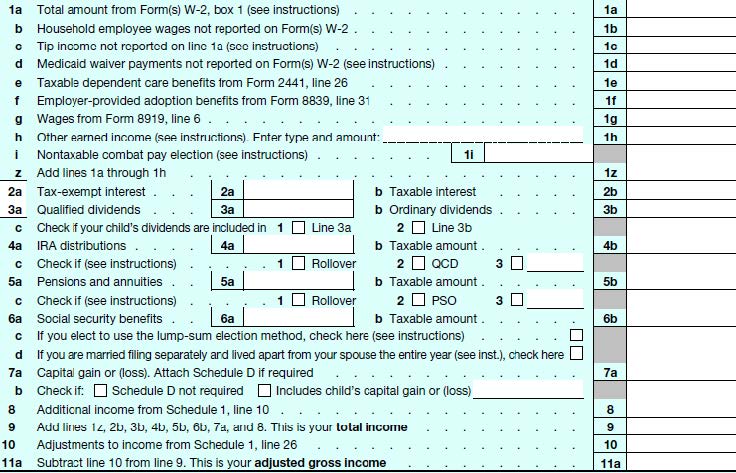
Retirement income such as payments from pensions or Social Security, as well as distributions
from pre-tax retirement accounts such as IRAs, are logged in sections 4-6 of the form.
Notably, only a maximum of 85% of Social Security benefits are subject to income tax, so the
gross benefit amount in box 6a should always be greater than the taxable amount reported in
box 6b. You can also note in these sections if a distribution from a retirement plan (say, a
rollover from a 401(k) to an IRA or a qualified charitable distribution) should not be taxed as
income.
Other, less common, types of earned income are also reported somewhere in this section of
the 1040. If necessary, a Schedule 1 is included to document other income sources like
rental real estate and business/partnership income that is distributed via a document known
as a K-1 that divvies up the total business income across its owners/partners. All of the
additional income that flows through Schedule 1 ends up in box 8 of the 1040.
Investment income earned in a non-retirement account (bank account, brokerage account)
also needs to be reported. Whenever you divest from interest in a capital property (real
estate, stocks, bonds, etc.), that generates a gain or loss that can affect that year’s taxable
income. Interest and dividend income go in sections 2-3 while capital gains from the sale of
aforementioned property are shown in section 7.
To get from total income to adjusted gross income (which the tax amount is based on), there
are some adjustments that can be made on Schedule 1. The most common are Health
Savings Accounts contributions, deductible IRA contributions, student loan interest
deductions, and deductible alimony paid. Once all this income and any relevant adjustments
are accounted for, you have completed the first page of your return!
Once you have total income in hand, the next page of the 1040 turns to deductions. The Tax
and Credits section first reduces your AGI by any appropriate deductions and then calculates
the total tax owed on that final income number shown in box 15. Every taxpayer is entitled to
a standard deduction ($15,750 for single filers and $31,500 for married taxpayers in 2025).
This is a freebie deduction that reduces your AGI and contributes to a lower tax bill. There
are additional deductions available if over age 65 and/or blind. If allowable itemized
deductions—from charitable giving, mortgage interest, state/local taxes, medical expenses
above 7.5% of AGI—are greater than the standard deduction, you can reduce your income by
that higher itemized deduction figure. For 2025 tax filing, the cap on deductible state and
local taxes has increased from $10,000 to $40,000 as long as your income is not too high so
this may lead to more people itemizing this year than before.
The calculation of federal taxes owed is usually best left to software or a professional
preparer, as not all income is assessed at the same rate. For example, earned income from a
W-2 is subject to the normal tax brackets but capital gains from realizing a profit on an
investment has different rates based on what your total income was for the year. A common
misconception is that once your income moves into a new tax bracket, then all your income is
charged that higher rate. In reality, the United States uses a progressive tax system, where
only the income in each bracket pays that rate. This means, if you go $10 over the 24%
bracket income level, only that $10 is charged the next bracket rate of 32% and all previous
income will pay 24% or less.
The Payments and Refundable Credits section settles your tax amount owed from the
previous section with all payments already made for the year. Frequently, taxpayers will
prepay most of their tax bill, either through tax withholding from paychecks or estimated tax
payments made over the course of the year. Sections 25-26 of the 1040 ensure you receive
credit for all of these prepayments. Any applicable additional credits are then added on to
the prepayments and the difference between these total payments and total tax owed
constitutes the refund amount or balance due. If you find yourself either with large balances
owed or sizeable refunds every year, it may make sense to adjust prepayments (withholding
from paychecks, estimated payments, or both) in order to avoid underpayment penalties for
not making enough prepayments as well as giving the government an interest-free loan,
which is essentially what is happening when too much withholding is taken throughout the
year and a large refund is paid back the following spring.
While the tax return documents and all the paperwork required can be intimidating, it really
just breaks down to adding up your income, calculating any allowable deductions or credits,
and then reconciling the resulting tax amount calculation with your payments made
throughout the year to determine how much you owe or are owed. We would be happy to
take a deeper dive into your specific situation if you have more intricate questions about your
taxes.
Reach out today. This could be the start of a great relationship.
Contact Us


